


Description
Children’s Words (Mots d’enfants) – Contemporary Painting Exploring Childhood, Dialogue, and Society
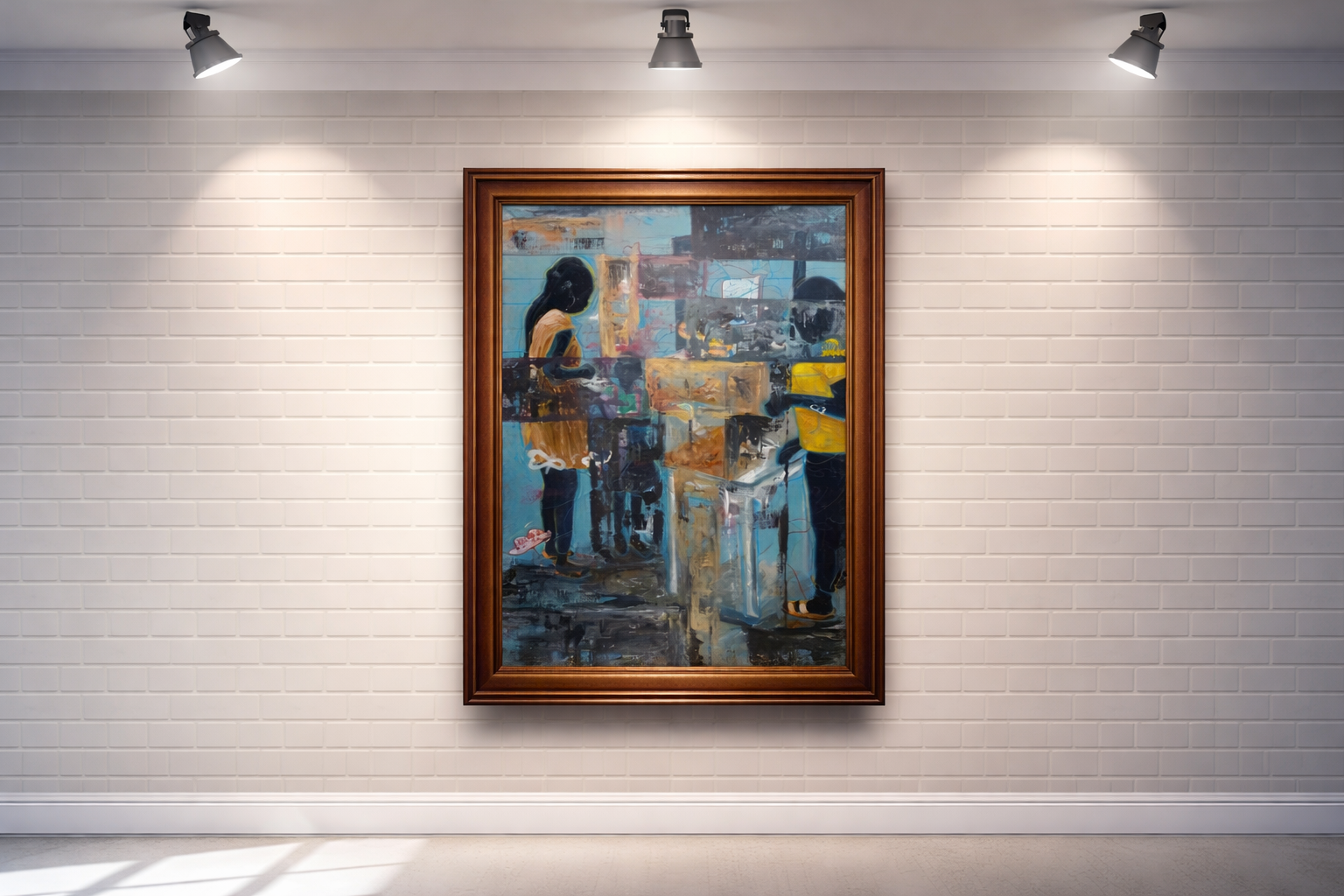
Children’s Words (Mots d’enfants) is a powerful contemporary artwork that examines the ongoing dialogue between childhood, motherhood, and society. The painting translates the spontaneous, inquisitive nature of children into a visual language, where words are not written but suggested through texture, gesture, and composition. At its core, the artwork is rooted in a simple observation: children speak freely, children ask many questions, and through these questions they reveal the deepest contradictions and truths of society.
The composition is intentionally fragmented, constructed through layers of paint, scraped surfaces, and overlapping forms. This visual fragmentation reflects the complexity of communication in the social world. Figures appear partially erased, dissolved into their environment, as if their voices are present but not fully heard. This echoes the reality of children’s speech — abundant, sincere, yet often overlooked in adult-centered spaces.
The maternal figure occupies a central symbolic role within Children’s Words. She represents listening, protection, and mediation. Positioned between the child and society, the mother absorbs questions, anxieties, and emotions, attempting to translate innocence into meaning. She embodies the emotional labor of motherhood, where dialogue is constant and answers are never complete. Through her presence, the artwork emphasizes that communication begins in the intimate space of family before expanding into the social sphere.
Color choices reinforce the emotional narrative of the painting. Cool blues evoke introspection, imagination, and the inner world of childhood. These tones contrast with warmer ochres, browns, and darker shades that suggest the weight of reality, urban life, and social constraints. This chromatic tension symbolizes the clash between a child’s natural curiosity and a society shaped by complexity and limitation.
The expressive brushwork and abstract figurative style give the painting a sense of movement and sound. The surface feels alive, almost noisy, as if conversations are unfolding within the layers of paint. The absence of clearly defined facial features allows the figures to become universal, enabling viewers to project their own experiences of childhood, parenting, and social interaction onto the scene.
Beyond its emotional depth, Children’s Words functions as a subtle social critique. It questions how societies listen to children and how often their voices are dismissed or silenced. The painting suggests that children are not passive beings; they are observers, thinkers, and participants in the social world. Their questions challenge norms, expose inconsistencies, and demand attention.
Ultimately, Children’s Words (Mots d’enfants) is an artwork about listening, dialogue, and responsibility. It invites viewers to reconsider the value of children’s voices and to recognize childhood as a powerful space of reflection. By transforming spoken questions into visual expression, the painting becomes a poetic reminder that society is constantly being shaped by the words of its children.


