


Description
Permanence – A Contemporary Artistic Perspective on Back-to-School Commerce
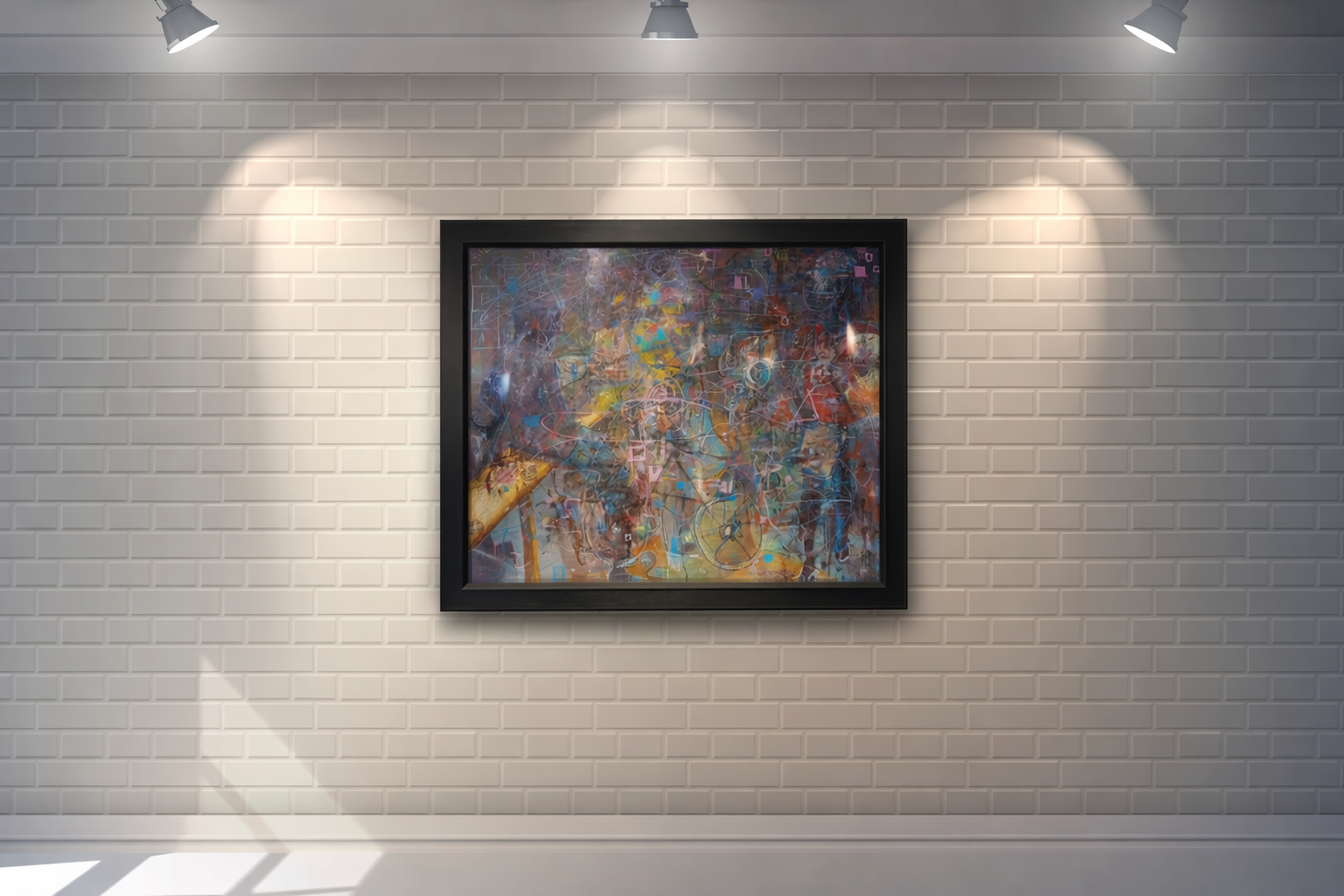
Permanence is a powerful contemporary artwork that explores the preparation for the school year through the lens of commercial activity. Rather than depicting a literal scene, the artist presents an abstract and expressive interpretation of a socially significant moment, where education, economy, and daily survival converge. The painting captures the intensity, repetition, and collective effort surrounding back-to-school sales, transforming a familiar event into a subject of artistic reflection.
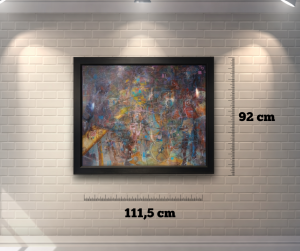
Dimensions: 115 x 92 cm
The composition is characterized by a dense accumulation of forms, colors, and gestural lines. This visual complexity reflects the bustling atmosphere that accompanies the start of the school year. Markets and shops become spaces of urgency and anticipation, where supplies are gathered, negotiations take place, and futures are quietly shaped. Through layered brushstrokes and overlapping elements, the artist conveys a sense of movement and constant activity, echoing the rhythm of commerce during this crucial period.
Color plays a central role in the narrative of Permanence. Vibrant tones interact with darker, more subdued hues, creating a balance between hope and pressure. Bright colors suggest the optimism and renewal associated with a new school year, while deeper tones hint at economic constraints and social responsibility. This contrast mirrors the lived reality of many families and vendors, for whom back-to-school preparation is both an opportunity and a challenge.
The fragmented visual language reinforces the idea of multiplicity. No single figure or object dominates the canvas; instead, everything coexists within a shared space. This approach emphasizes the collective nature of back-to-school commerce. Vendors, parents, students, and institutions are all part of the same system, bound together by necessity and expectation. The artist’s abstraction allows viewers to recognize familiar patterns without imposing a fixed interpretation, making the experience both personal and universal.
At its core, Permanence highlights the role of trade as a fundamental link between education and society. The act of selling school supplies becomes a ritual, repeated year after year, marking the continuity of social life. This repetition gives meaning to the title of the artwork. Permanence refers not only to the recurrence of the school year but also to the resilience of those who prepare for it. Despite economic uncertainty, the cycle continues, sustained by effort, adaptability, and collective will.
The artwork also invites reflection on the often-overlooked labor behind education. Before learning begins in classrooms, it starts in markets, shops, and streets. The preparation phase is essential, yet rarely acknowledged. By focusing on this moment, the artist sheds light on the invisible structures that support access to knowledge. Commerce is presented not merely as an economic activity, but as a social function deeply tied to the future of children and communities.
Stylistically, Permanence aligns with contemporary abstract expression, where emotion and movement take precedence over realism. The surface of the painting feels alive, almost chaotic, encouraging viewers to engage closely and discover details within the layers. This immersive quality mirrors the experience of navigating crowded markets during the back-to-school period, where voices, colors, and objects blend into a single sensory field.
Ultimately, Permanence is a social and economic narrative expressed through abstraction. It speaks of continuity, responsibility, and shared effort. The artwork reminds us that education is not an isolated process but part of a broader ecosystem involving commerce, labor, and community. By transforming the preparation for the school year into a visual statement, the artist elevates an everyday reality into a meaningful and thought-provoking work of contemporary art.
Permanence stands as a compelling piece for collections focused on social themes, contemporary abstraction, and the intersection between education and economic life.


